Provenance:
European Private Collection
American Private Collection
Published:
Jane Casey, Taklung Painting, A Study in Chronology, Volume I, Chicago, 2023, cat. no. 43, pp. 367-369
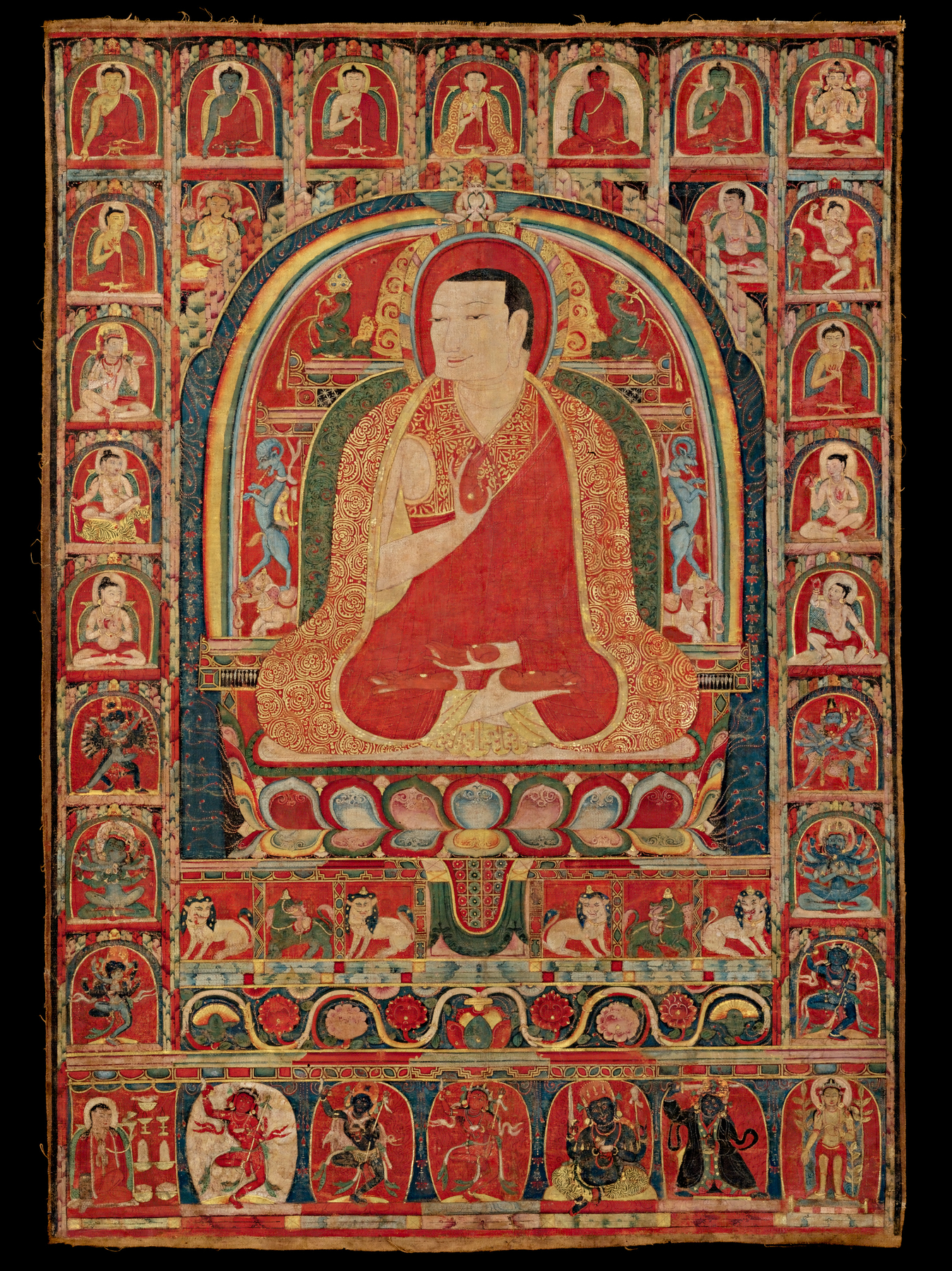
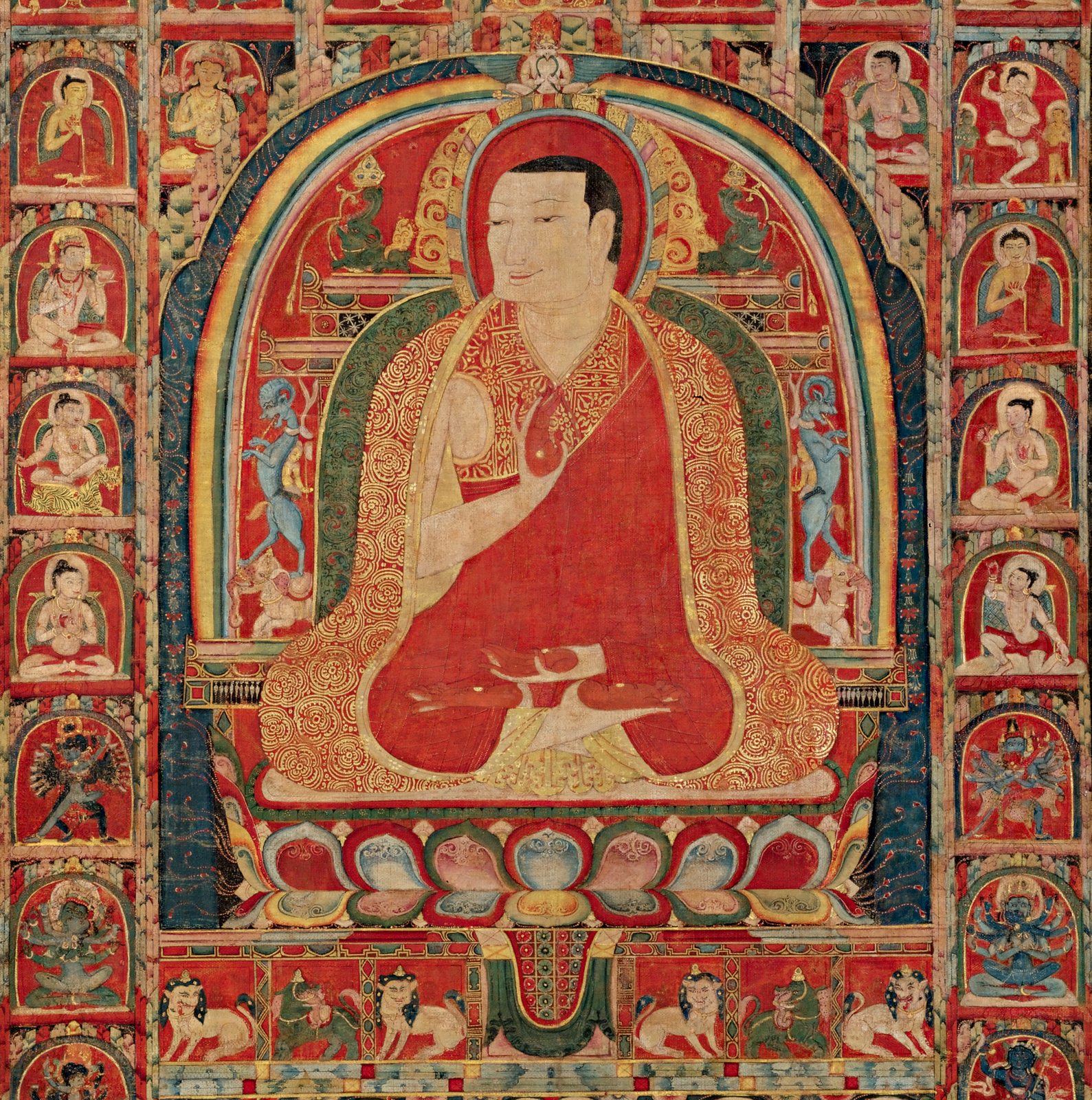
The Abbot is depicted seated in the lotus position with his hands in abhaya mudra, signifying protection and overcoming fear. He is represented with youthful features, enthroned within a rainbow arch, a motif associated with spiritual accomplishment and sanctity.
Beneath multi-colored lotus petals, his throne is protected by four white snow lions and two green elephants and is flanked on each side by a leogriff atop an elephant, makaras perched on the cross bar above. Tashipel, the Taklung founder, appears above the central figure, and the patron appears in the lower left corner. The Eight Great Adepts are in the two vertical registers.
Casey notes the inscription in red script begins with the mantra of All Knowledge. Although worn and partly illegible, it invokes all the Taklung lineal teachers from at least Tilopa through Tashipel, Kuyalwa, Sangye Yarjon, and Sangye On. The ye dharmä verse begins after his name, followed by the Tibetan precept verse of patience, the near-heart mantra of Samvara, the long mantra of Vajrayogini, the Tibetan prayer for the teacher's blessing, the prayer not to be separated from one's teacher and his successors, and a partly illegible prayer for the realization of one's aspirations. That Sangye On is the last teacher invoked in the inscriptions indicates he was the teacher of those who commissioned the painting, as established by an assessment of the Taklung verso inscriptions as a whole. Using the inscription as a guide to chronology, the painting may have been commissioned any time after 1272, when Sangye On assumed the abbot's chair at Taklung, until circa 1310, when the Second Riwoche Abbot assumed his position at Riwoche.
The closest style comparisons are with paintings produced during the tenure of the Second Riwoche Abbot (1310-1366), or paintings generally ascribed to the 14th century. The lotus petals with frothy tips beneath the throne seat are very similar to those in the circa-14th century portrait of Marpa in the Pritzker Collection. The attenuated leogriffs are like those in a portrait of Phagmodrupa, also attributed to the 14th century. The roaring lions in the throne base, heads turned to look over their shoulders, are similar to those in The Metropolitan Museum's Nanatapa painting produced during the tenure of the Second Riwoche Abbot (1304-1366). Both lions wear golden lotus-bud caps, otherwise rarely seen; see Steven M. Kossak and Jane Casey Singer, Sacred Visions: Early Paintings from Central Tibet, Metropolitan Museum of Art exhibition catalogue, 1998, pp. 131–33, cat. no. 33.