
Provenance:
The Richard R. & Magdalena Ernst Collection
Sotheby’s, New York, March 22, 2018, no. 967
Published:
Jeannine Auboyer and Gilles Béguin, Dieux et démons de l'Himâlaya: Art du Bouddhisme lamaïque, exhibition catalogue, Paris, 1977, p. 164, cat. no. 177
Exhibited:
"Dieux et démons de l'Himâlaya: Art du Bouddhisme lamaïque," Grand Palais, Paris, March 25– June 27, 1977, Haus der Kunst, Munich, August 5 – October 16, 1977
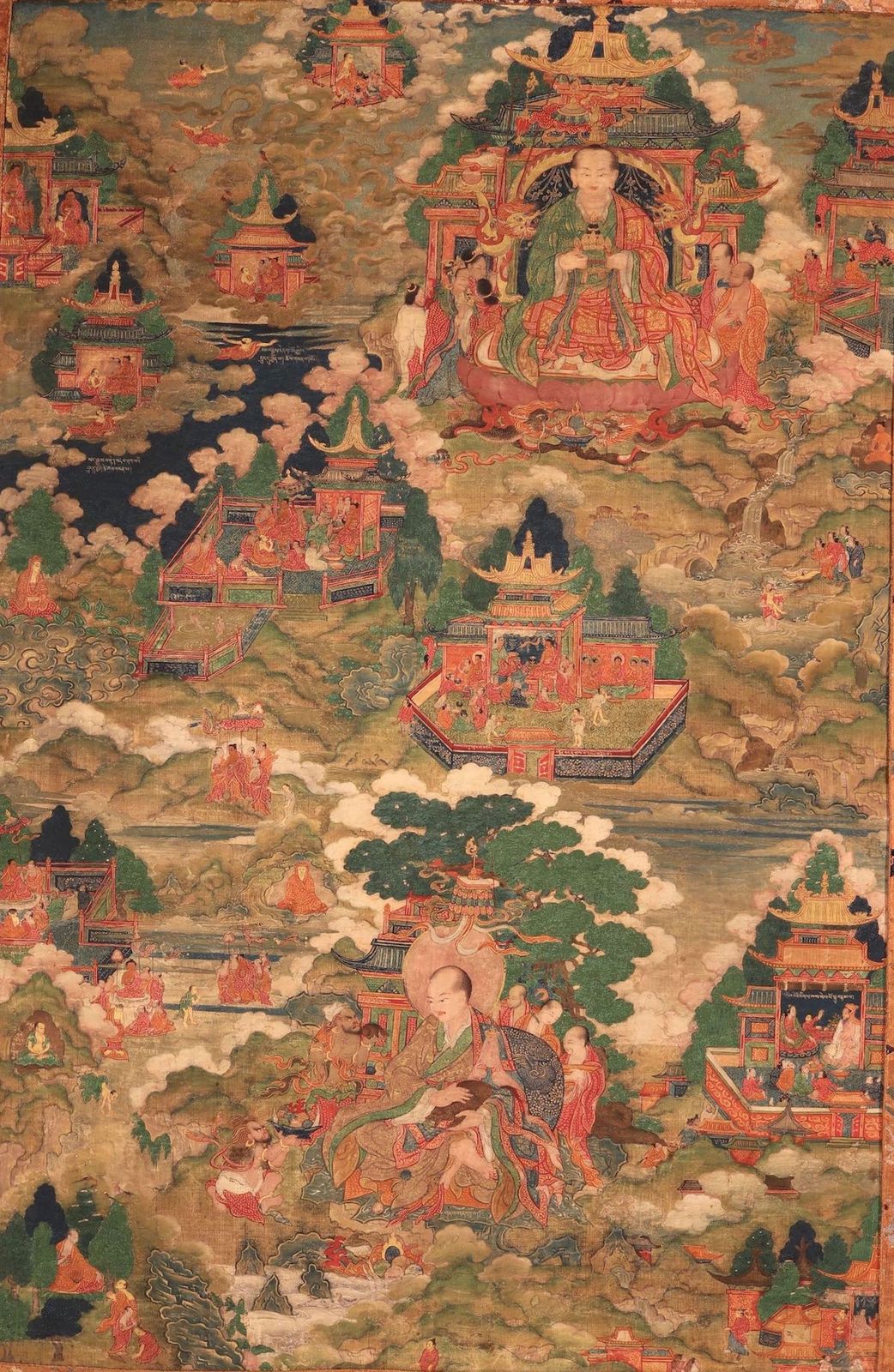
This lively thangka presents two of Buddhism's most revered arhats, Rahula and Bakula, within an expansive landscape filled with temples, pavilions, attendants, and sacred mountains. Rather than isolating the figures against a simple background, the artist creates an intricate world that invites the viewer to travel through the composition, discovering episodes and secondary figures woven throughout the terrain.
Rahula appears in the upper portion of the painting seated upon a dragon-supported throne within a celestial setting. He holds a golden crown before his chest, his principal identifying attribute among the sixteen arhats. Below, Bakula is shown seated beneath a large tree in the northern paradise of Uttarakuru. He cradles a mongoose (nakula), the attribute most closely associated with him in Tibetan Buddhist art. Traditionally, the mongoose is depicted as a bestower of wealth and abundance, symbolizing Bakula's role as a beneficent protector of practitioners.
The painting is animated by a multitude of subsidiary scenes. Temples and pavilions emerge from banks of clouds, while monks, attendants, and deities populate the landscape. Small groups of figures gather in courtyards and along mountain paths, creating a sense of continual activity. The artist organizes these elements through a layered arrangement of peaks, architecture, and swirling clouds that guides the eye upward through the composition. Rather than representing a single earthly location, the landscape evokes the sacred realms associated with the arhats and their retinues.
Rahula and Bakula belong to the group known as the Sixteen Arhats, enlightened disciples of the Buddha who were believed to remain in the world to preserve and protect his teachings. The present painting reflects that tradition through its combination of identifiable arhat imagery and richly-detailed setting. The crown held by Rahula and the mongoose carried by Bakula distinguish the two figures, while the surrounding landscape expands their presence into a vividly-imagined sacred world.
