
Provenance:
European Private Collection
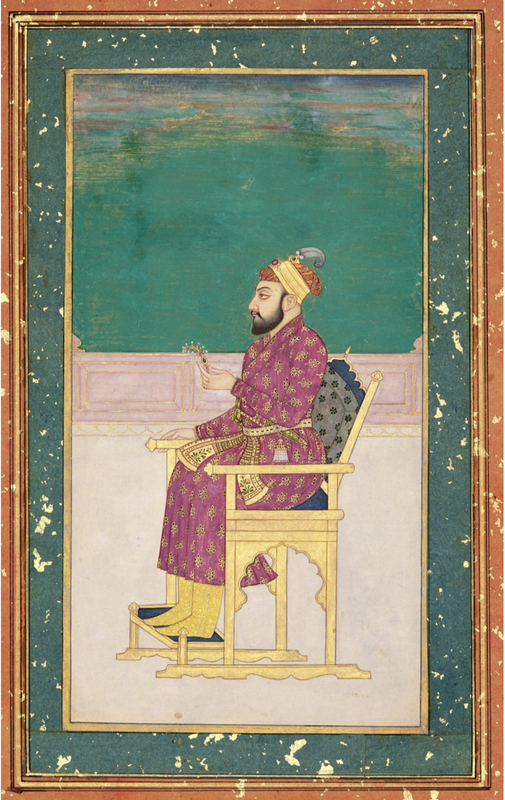
The devanagari inscription on the reverse of the painting suggests that Nawab Sipahdar Khan was the son of Khan Jahan Bahadur, the most senior general in Aurangzeb’s imperial army. He was noted for vanquishing the independent Maratha leader Shivaji, thereby facilitating the Mughal conquest of the Deccan. He was awarded the titles Khan Jahan Bahadur Zafar Khan in 1674. His full name, Khan Jahan Bahadur Zafar Khan Kokaltash, indicated that he was a foster-brother of Aurangzeb, who held him in great esteem and affection.
Nawab Sipahdar Khan in painted in strict profile, seated with composed dignity upon an elevated throne-like chair. The figure is set against a luminous, flat turquoise ground framed by a wide border. The nawab is depicted in a moment of quiet contemplation, delicately holding what appears to be a jeweled ornament or sprig, an object that underscores both refinement and courtly leisure. His physiognomy—arched eyebrow, almond-shaped eye, and carefully groomed beard—reflects the stylized elegance associated with the Kishangarh atelier, where idealization and poetic restraint were prized over strict naturalism.
Particular attention is given to the sumptuous costume and the architectural rendering of the seat. The nawab wears a richly-patterned jama in deep rose, densely ornamented with repeating floral motifs picked out in gold, tied at the waist with an intricately decorated sash. Beneath, a translucent jama extension reveals golden trousers, while his footwear—delicately pointed and also gilded—rests on a small footstool. His turban, wrapped in soft ochre tones and adorned with a plume and jeweled ornament, signals noble rank and refinement. The chair itself is an exquisite object: constructed in a pale golden hue, it features a high back with a dark upholstered cushion patterned in subtle floral forms, projecting armrests, and elegantly carved supports with cusped arches—a motif resonant with Mughal architectural vocabulary. The inclusion of a footrest further elevates the sitter, both literally and symbolically, reinforcing his elite status within the courtly hierarchy.