Provenance:
Sotheby's, London, June 5, 1989, no. 133, cover illus.
Bumper Development Corporation Collection, Canada, 1989-2017
Bonhams, New York, March 16, 2021, no. 322
New York Private Collection
Exhibited:
On loan to the Glenbow Museum, Calgary, 1989-2015
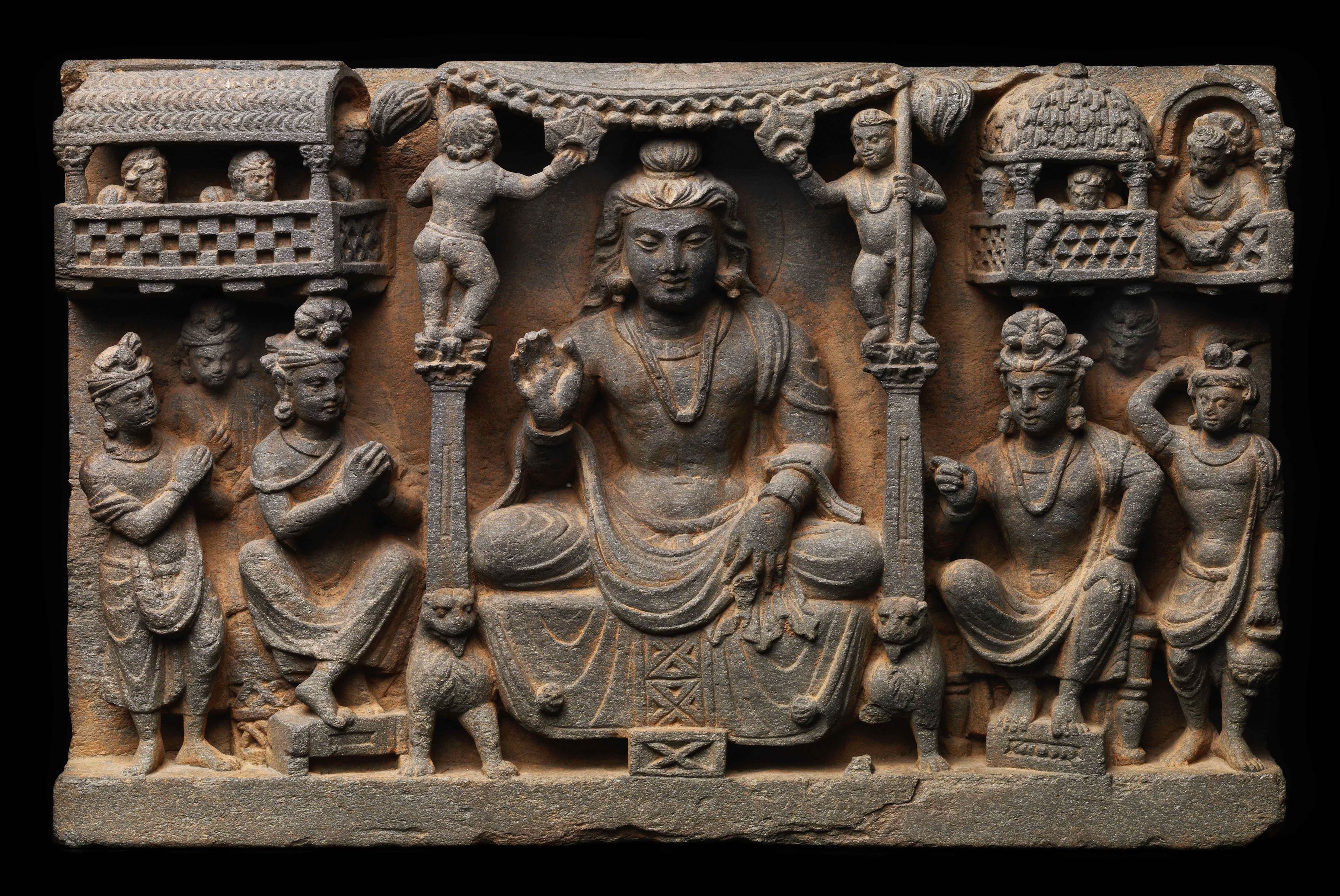
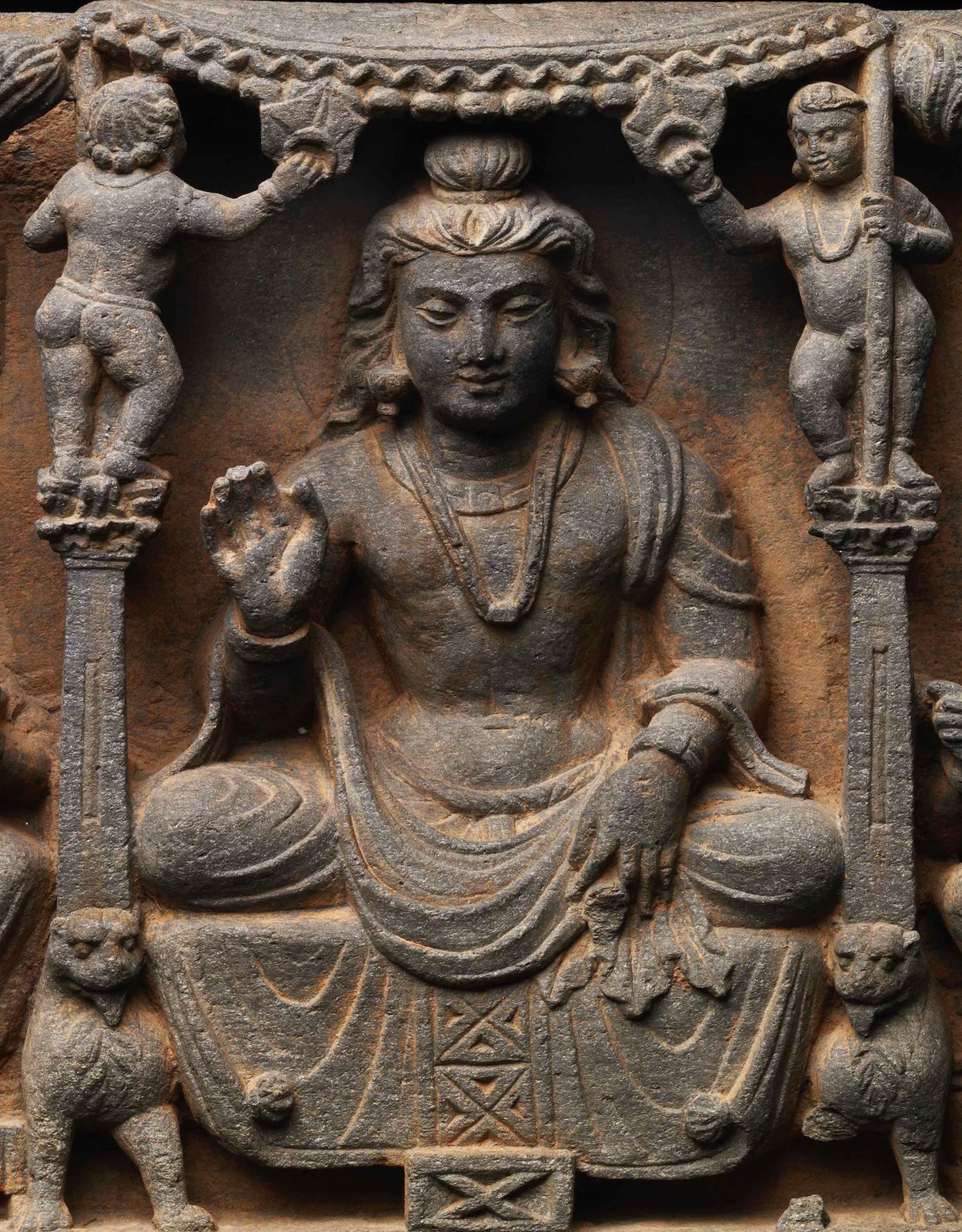
This finely-carved relief panel depicts Maitreya (“The Benevolent One”), the future Buddha, shown enthroned in Tushita Heaven as a bodhisattva awaiting the moment of his final rebirth. Seated beneath an elaborately-rendered baldachin, Maitreya occupies the compositional and symbolic center of the scene, his monumental presence emphasized by symmetrical framing elements and hierarchical scale. His calm, idealized features, carefully-articulated drapery, and poised bearing reflect the Gandharan synthesis of Indic religious iconography with Hellenistic sculptural naturalism.
Flanking him are two attendant bodhisattvas, one seated on a distinctive wicker stool—an iconographic motif common in Gandharan art that signals both status and ascetic refinement—while others stand in attitudes of reverence. Above, winged putti fan the central figure, standing on the capitals of columns that rise behind a pair of lions, whose vigilant presence reinforces the protective and regal character of Maitreya’s throne.
The architectural setting is rendered with remarkable narrative richness and spatial complexity. Thatched and leaf-covered balconies, supported by beams intricately carved on their undersides, frame the upper register of the relief, evoking a celestial palace environment. These balconies are populated by figures identified as fortunate beings reborn in Tushita Heaven, who observe and participate in the scene. Their varied postures and gestures introduce a lively sense of movement and human engagement, enhancing the dramatic immediacy of the composition. In the upper right corner, a woman prepares to scatter flowers from an arched balcony, a ritual gesture of devotion that underscores the sacred status of Maitreya and the atmosphere of celestial celebration. The careful integration of architectural motifs and narrative detail reflects Gandharan sculptors’ sophisticated command of spatial illusion and compositional balance, informed by Greco-Roman traditions of relief carving. For other reliefs depicting this subject see Ingholt, Gandharan Art in Pakistan, New York, 1957, no 37; and Zwalf, A Catalogue of the Gandharan Sculpture in the British Museum, London, 1966, no. 251.
Within the broader context of Gandharan art, this panel exemplifies the region’s distinctive approach to Buddhist narrative and devotional imagery. Gandhara, situated at the crossroads of South Asia, Central Asia, and the Mediterranean world, developed a highly-syncretic visual language during the early centuries of the 1st millennium, blending Hellenistic naturalism with Buddhist symbolic and doctrinal concerns. The use of classical architectural elements, putti, and perspectival structuring reveals a deep engagement with Greco-Roman models, while the iconography of Maitreya in Tushita Heaven reflects Mahayana doctrinal developments and devotional practices centered on hope for future salvation. Such narrative reliefs likely adorned stupas and monastic complexes, serving both didactic and contemplative functions. As such, this panel not only demonstrates the technical and artistic sophistication of Gandharan workshops but also offers valuable insight into the evolving religious imagination and intercultural exchanges that shaped early Buddhist art.