Provenance:
Clarice Goldstone Collection
Rossi & Rossi, Ltd., London
New York Private Collection
Pubished:
Rossi & Rossi Ltd., Beyond Lhasa: Sculpture and Painting from East and West Tibet, London, 2002, no. 18
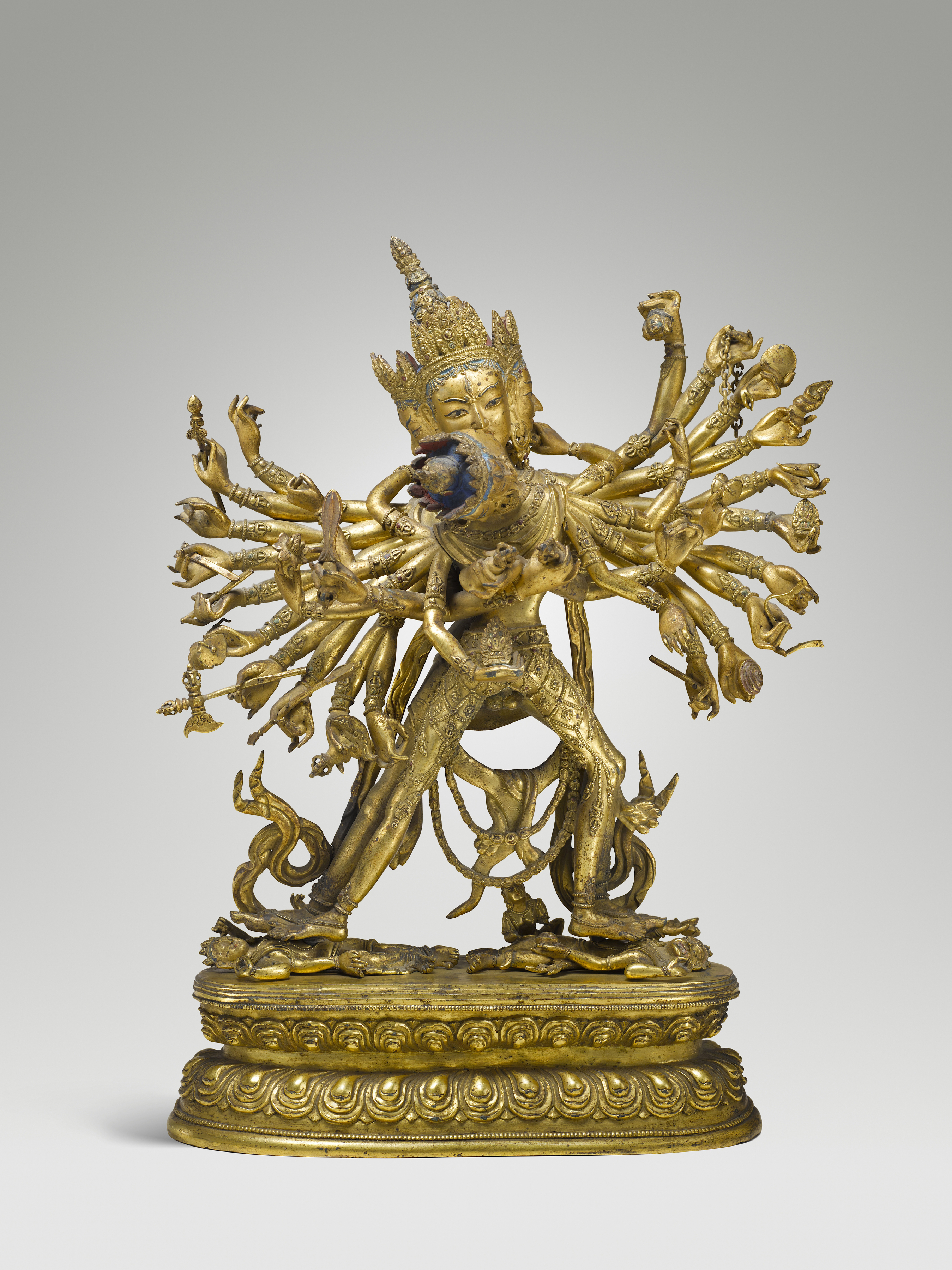
Standing in a wide alidha asana, the deity embraces his consort while the surrounding arms extend in measured arcs that frame the pair from every direction. Although the sculpture contains a large number of figures, limbs, and ritual implements, the central embrace remains the visual focus. As the sculpture is viewed from different angles, the relationships among the arms, hands, and attributes continually shift, revealing the sculptor's careful orchestration of space.
Kalacakra, the "Wheel of Time," is one of the principal deities of the Anuttarayoga tantras, the final phase of Esoteric Buddhist literature that emerged in northern India during the late first millennium. The Kalacakra cycle was translated into Tibetan during the early eleventh century, where it became one of the most influential tantric traditions. Its teachings unite ritual practice, meditation, cosmology, and astronomy within a comprehensive vision of the relationship between the individual and the universe. The deity's multiple heads, arms, and attributes give visual form to this expansive religious system.
The sculpture is organized around a strong central axis. The broad stance anchors the figures on the lotus pedestal, while the embrace of Kalacakra and Visvamata establishes the center of the composition. Around them, each arm occupies a distinct position, creating a rhythmic pattern that unfolds evenly across the sculpture. The arrangement remains coherent from every viewpoint, allowing the eye to move naturally between the central figures and the surrounding circle of ritual implements.
Fire-gilded surfaces retain a rich, luminous finish, while painted decoration survives on the faces, hands, and feet. Jewelry, textiles, and crown ornaments were carefully chased after casting, adding finely-worked surface detail throughout the sculpture. The slender proportions of the intertwined figures contrast with the expansive circle of arms, while the lotus pedestal provides a broad visual foundation for the composition. These qualities relate closely to sculptures produced during the Qianlong period (1736–1796), when Tibetan Buddhism received sustained patronage at the Qing court and imperial workshops produced works in the Himalayan tradition. The refined casting, gilding, and elegant proportions place this sculpture within the broader tradition of eighteenth-century Sino-Tibetan Buddhist metalwork.